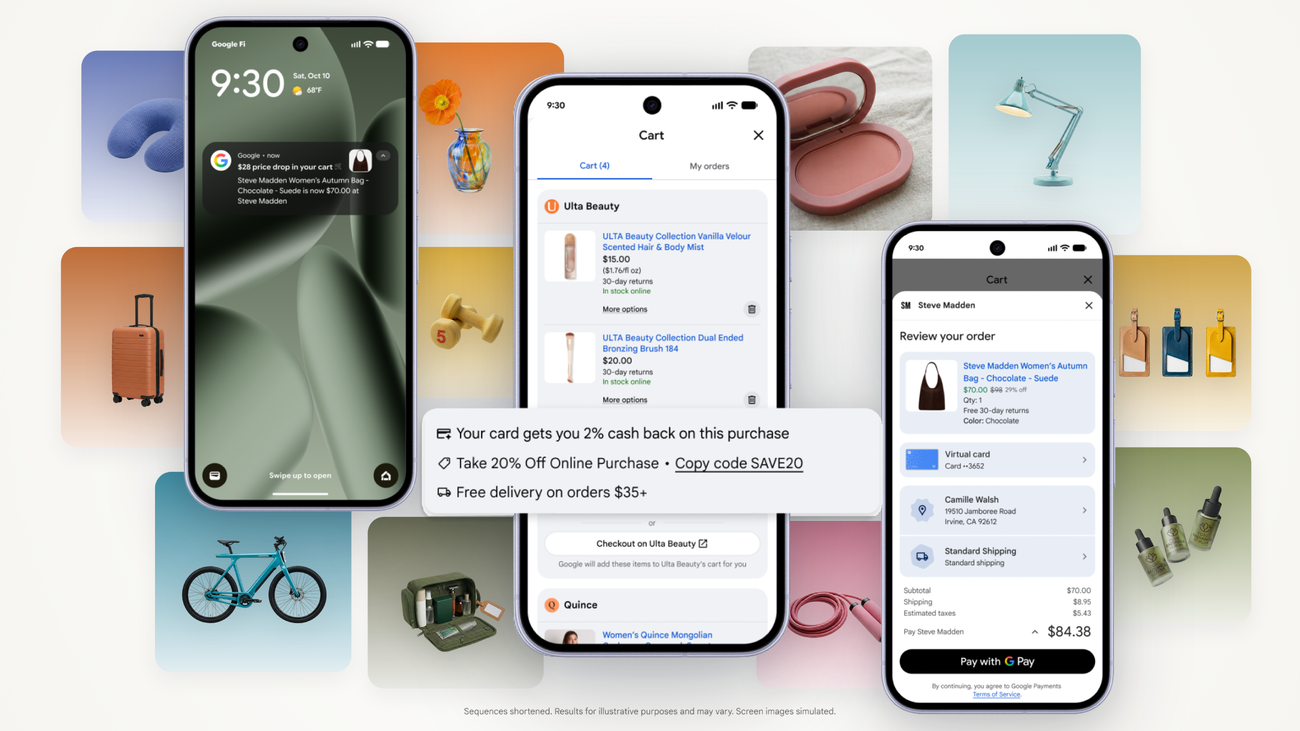
On October 15, 2026, Google made Universal Cart available to US users of Search and the Gemini app. This cart brings together products from multiple retailers, alerts users to price drops and restocks, and suggests the most advantageous payment method based on the cards saved in Google Wallet. Checkout is handled through Google Pay at selected merchants, including Nike, Sephora, Target, Ulta Beauty, Walmart and Wayfair, with the merchant remaining the seller of record. The system is built on the Universal Commerce Protocol introduced at the I/O conference in May, a topic that retailers attending NRF in January will be able to assess against holiday season figures.
Why it matters
Google is positioning itself between the customer and the retailer at the crucial shopping cart stage, where purchase intent and price trade-offs become apparent. For retailers, what is at stake is control over the customer relationship and transaction data, even if they remain sellers of record. Actual adoption during the holiday season remains to be measured, with a released version that is more limited than the one announced in May.
What to take away
Universal Cart is not simply a comparison tool: it is a persistent cart hosted by Google, powered by a Shopping Graph that claims more than 60 billion product listings and connected to the user's wallet. By leaving the merchant as the seller of record, Google avoids a head-on conflict with retailers while capturing the most valuable signals along the shopping journey: intent, price comparison and choice of payment method. The released version remains more modest than the one presented at I/O, with no announced integration with YouTube or Gmail.
For retailers, the question is no longer whether to be present in these interfaces, but on what terms. Being readable by the Universal Commerce Protocol is becoming a prerequisite for visibility, much as search engine optimization was twenty years ago. Retailers that have joined the system gain traffic at the cost of increased dependence on an intermediary that also knows their competitors. At NRF in January, the first feedback from the holiday season will indicate whether this cross-retailer cart actually shifts sales or remains a price-monitoring tool for savvy consumers.
In detail
- Event
- NRF matin
- Category
- AI applied to retail and shopping agents
- Region
- États-Unis
- Published
- 22 October 2026
- Companies mentioned
- Google, Nike, Sephora, Target, Ulta Beauty, Walmart, Wayfair, Shopify
Original source: Google (blog officiel)
Read the sourceGoogle (blog officiel), quoted by Back from Tech Events, 22 October 2026. Summary rephrased; read the source for the full text.
AI-assisted news watch, following the Back from Tech Events editorial line